
Industry
Nonprofit/Charitable
Challenge
An industry-leading guide dog school faced rising work-related musculoskeletal injuries that shortened trainers’ careers. Unable to retain staff beyond five years, the company was losing money from the high cost of training team members and was unsure where to begin.
Results
Over the six week program, participants experienced a significant increase in their functional movement, directly correlating with a decreased risk of musculoskeletal injury.
Key Products
Industrial Sports Medicine™, Wearable Sensor Technology
The Challenge
An industry-leading guide dog school was facing a growing workforce challenge driven by the physically demanding nature of its trainer roles. Trainers routinely performed repetitive lifting, bending, walking, and animal-handling tasks that placed significant strain on the body, leading to a steady rise in work-related musculoskeletal injuries.
The impact extended far beyond employee discomfort. High physical demands and recurring injuries contributed to elevated turnover rates, with many trainers leaving the organization before reaching five years of tenure. As experienced employees departed, the school faced ongoing losses in institutional knowledge, reduced team continuity, and increasing costs associated with recruiting, onboarding, and training new staff.
Leadership understood that the issue was affecting not only employee well-being, but also the long-term sustainability and effectiveness of the organization’s mission. However, without a clear strategy to proactively reduce injuries and improve employee retention, the organization struggled to identify the right path forward.
The Solution
With strong leadership support and a shared commitment to improving employee well-being, Briotix Health implemented a customized Industrial Sports Medicine™ (ISM) program designed to proactively reduce injuries, improve trainer health, and enhance long-term workforce sustainability.
The comprehensive program combined onsite support, advanced wearable technology, personalized wellness strategies, and individualized job coaching to create a data-driven approach focused on both injury prevention and employee performance optimization.
WEARABLE EVALUATIONS AND MOVEMENT SCREENING
To gain objective insight into physical demands and movement patterns, trainers participated in wearable sensor evaluations and functional movement screenings. The wearable technology captured real-time biomechanical data, helping identify high-risk movement behaviors, physical strain, and potential injury risk factors that may not have been visible through traditional observation alone.
PERSONALIZED WELLNESS PLANS
Using assessment findings and movement data, Briotix Health developed customized wellness plans for each trainer that focused on improving strength, mobility, safe movement mechanics, and cardiovascular conditioning. Rather than applying a one-size-fits-all approach, each plan was designed around the trainer’s current physical capabilities, daily work demands, and injury risk profile.
ONE-ON-ONE JOB COACHING
An onsite Briotix Health ISM provider worked directly with trainers through individualized job coaching sessions conducted within the actual work environment. During these sessions, the provider evaluated job tasks, work habits, and environmental factors contributing to physical strain and fatigue.
Using real-time observations and employee assessment data, the provider delivered practical movement modifications, ergonomic recommendations, and task-specific coaching designed to help trainers perform essential job functions more safely and efficiently based on their current functional abilities.
Together, these interventions created a proactive, technology-enabled injury prevention strategy that helped support employee health, improve workplace performance, and strengthen long-term trainer retention.
The Results
Over the six-week program, participants demonstrated a significant improvement in functional movement, which is directly associated with a reduced risk of musculoskeletal injury. The data showed that targeted movement training, personalized wellness strategies, and individualized coaching not only improved employee health outcomes but also enhanced overall physical readiness for the demands of the job.
Implementation of the program reduced Chronic Disease Risk to 12.5% and produced an 11.11% increase in Functional Body Movement. The program also generated exceptionally positive employee feedback, with 100% of participants reporting they were satisfied or highly satisfied with their customized exercise and wellness program.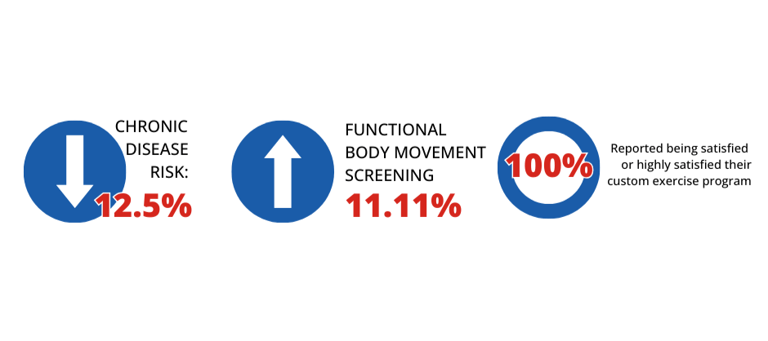
Ready to learn more about Industrial Sports Medicine™ solutions?
